
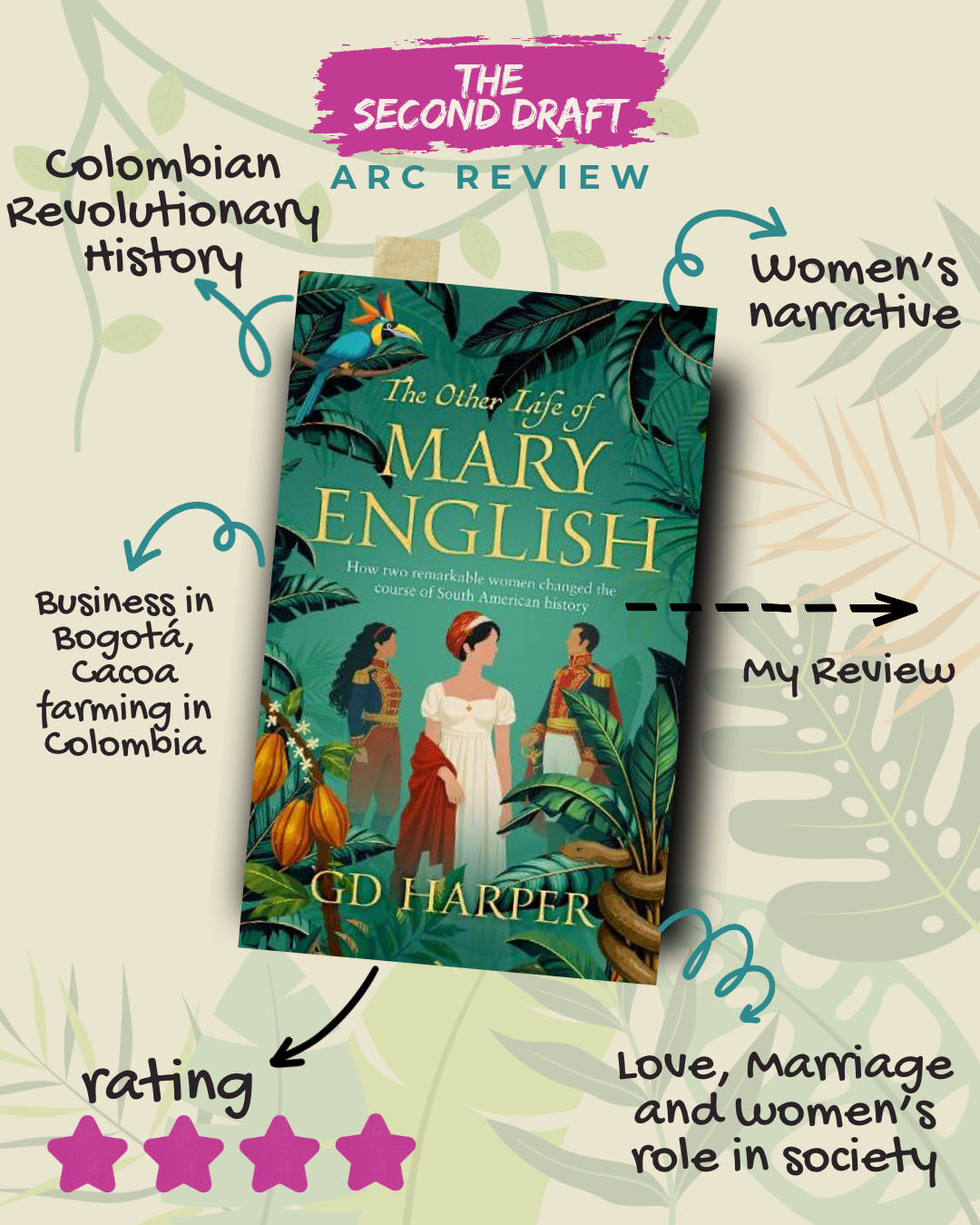
A richly researched journey through Colombia’s revolutionary history, with one compelling heroine and another I wanted to know better.
There are books that send you straight into another book, and books that send you off looking up the history behind them. The Other Life of Mary English had me reading more about Colombia, a country whose history I knew embarrassingly little about before picking it up.

One of its great strengths is how naturally that history becomes part of the story. The tensions of the revolutionary period emerge through the characters’ lives and relationships, giving me a way into events I might otherwise have struggled to follow. There is a lot to take in, but I came away feeling that I had learned something without spending the whole novel feeling like I was being taught.
The Offical Blurb
Two Different Women. One Shared Destiny.
Mary English, a dockworker’s daughter from Faversham, England, travels to South America to escape a scandal from her past. She ends up running a cacao plantation in Colombia, at a time when women were not legally allowed to own businesses there.
Manuela Sáenz, tempestuous lover of Venezuelan revolutionary Simón Bolívar, serves as a colonel in his army. She joins him in battle to fight the Spanish and twice saves his life from assassination attempts.
This is the story of two real-life remarkable women, both fighting oppression, hardship and danger in 1820s Colombia, who come together to change the course of a nation’s history.
A history I wanted to know more about
The setting deserves particular praise. Colombia shapes the story, from its political upheaval to the expectations governing women’s lives. The research feels substantial, and the historical pictures, paintings and maps included in the middle of the book were a lovely addition. There is clearly a great deal of work behind this novel, and I appreciated it.
I also appreciated the repeated mentions of cocoa and guava. I’m still not entirely sure how these were being served, but I wanted some every time they appeared!
Two women, two very different experiences
The two female perspectives gave me rather different reading experiences. Mary was easily my favourite. Through her, we see the restrictions placed on women, but also the space she finds to make decisions within them. She runs businesses, hosts society gatherings, chooses her husband and later runs a farm. As the belle of Bogotá, she moves among interesting people, including Simón Bolívar, but her story retains a sense of being her own. Her choices emerge from her circumstances, her priorities and her concern for her daughter.

I found Manuela more frustrating, partly because she had so much going for her. Here was a woman involved in the army, working as a spy and standing up to powerful men. I wanted to know more about her ambitions and convictions, yet her motivations seemed to return, again and again, to her love for Simón.
That love can absolutely be an important part of her story. I just wanted more of the person around it. At times, her fiery temperament also felt like shorthand for a more complicated personality, leaving her less fully developed than Mary.
I’m aware this is historical fiction, and I’m quite happy for authors to take some creative licence in shaping a story. In fact, I wondered whether a little more of that freedom might have given Manuela a fuller inner life. I didn’t need her devotion to Simón removed; I wanted to feel that there was more to her than that devotion.
When the history slows the story
My other reservation was the pacing. There are stretches where the characters relay the actions of other people, often elsewhere or at another time, and the immediate story loses some momentum. The history remained interesting, but I occasionally wanted to spend more time watching events unfold and less time hearing them recounted.
A lovely read that sent me looking for more
Still, this was a really lovely read: rich in historical detail, grounded in its setting and compelling enough to make me want to learn more. Mary’s story was a particular highlight, and although the pacing and Manuela’s characterisation kept it from five stars, it left me with plenty to think about… and a growing curiosity about Colombian history.
Thank you to Love Book Tours and GD Harper for providing a copy of The Other Life of Mary English in exchange for an honest review. All opinions are my own.
Author Bio
GD Harper is an award-winning author of psychological thrillers and historical fiction, including The Other Life of Mary English. He lives in East Sussex and, when not writing, can be found wild camping in the Scottish mountains or in the mosh pit at live music events.
Instagram: @GDHarperAuthor
Website: www.gdharper.com
Buy it here on Amazon


Review by Emma Sinclair
Emma Sinclair is a Scottish writer and book reviewer behind The Second Draft. She writes about books, culture and the things she can’t stop thinking about, from speculative fiction and internet history to the odd ideas hidden between the pages.

Follow me on Instagram!


