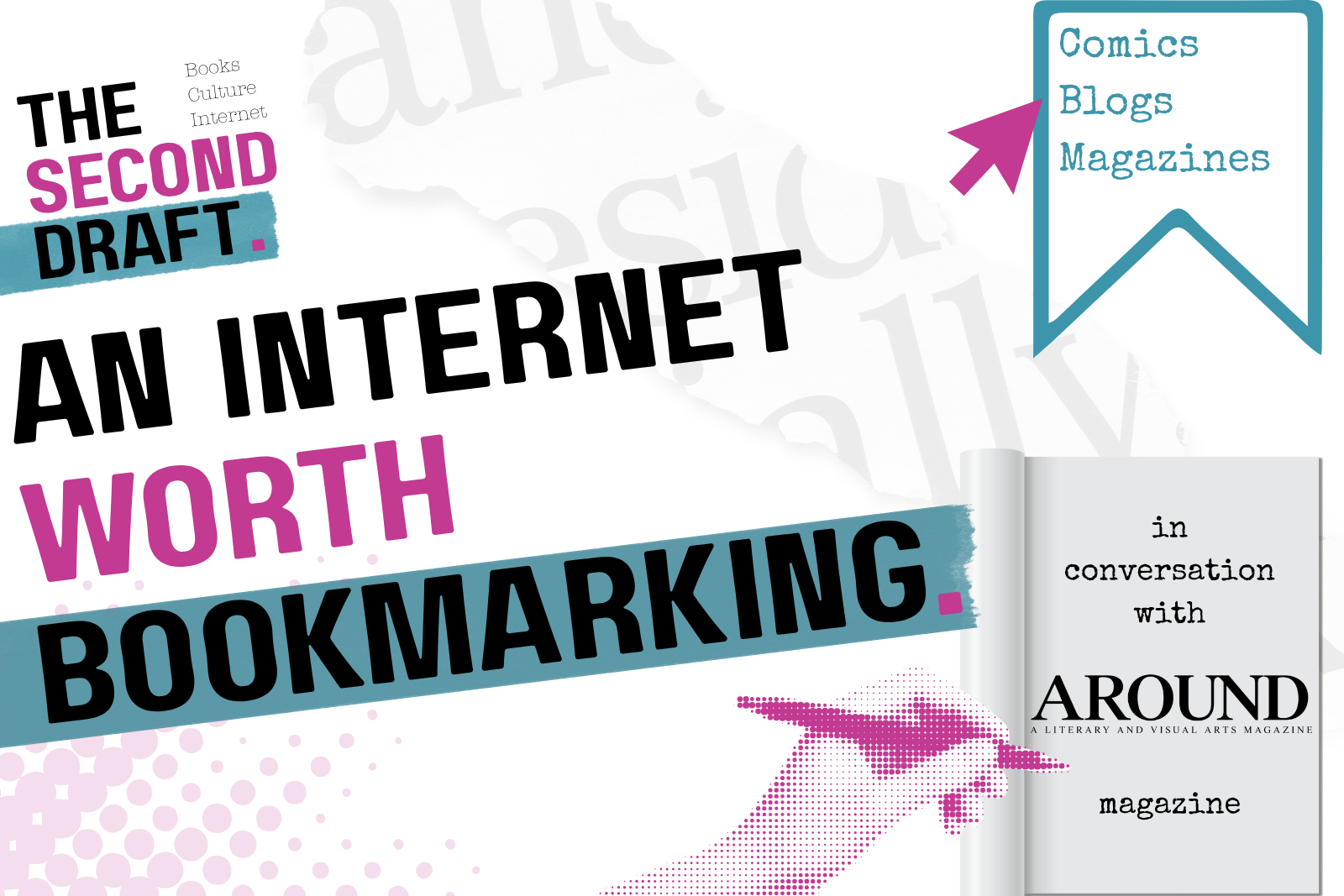
An email about a magazine recently sent me down a very specific hole.
Alexander Dzhoganov had contacted me about AROUND, an independent online publication bringing together poetry, prose, photography and painting. I was interested enough to ask him some questions. Somewhere between looking at the concept and reading his answers, I found myself thinking about being at university in 2008 and 2009, checking whether somebody had updated their webcomic.
This was an activity that once occupied a perfectly reasonable amount of my day.

I had favourites. Anders Loves Maria (I will still never forgive Anders). xkcd. YU+ME: Dream, which was fascinating to follow as it unfolded and her art style changed over the years. These were individual places I visited, each with its own appearance, humour and rhythm. I bookmarked them and went back to check for something new.
Sometimes there was an update. Sometimes there wasn’t. Occasionally, I would check again, demonstrating a touching faith in the possibility that someone had drawn an entire comic since my previous visit.
What caught me in Alexander’s answers was his hope that readers would add AROUND to their browser bookmarks.
I hadn’t realised how much affection I still had for that small, ordinary act.
The daily rounds
The internet of my first university years felt raw. Facebook still had the novelty of somewhere people were actively arriving. I remember refreshing it to see who was around and working through feeds that felt like timelines: the newest thing at the top, followed by the things that had happened before it.
My memories are hardly a technical history of the internet. They are memories of how I used it, and of how much of that use involved deciding where to go.
I went looking for things that made me laugh, interested me or gave me a story to follow. Once I found them, they became part of my daily rounds. Open a page. Check for an update. Move to the next one. Webcomics occupied some of the space that memes and short videos occupy in my life now. They provided small, repeatable pleasures, sometimes silly and sometimes unexpectedly absorbing. Following a continuing story also meant waiting for its creator to tell the next part. The anticipation belonged to the experience.
Then there was the peculiar delight of meeting somebody else who had found the same thing.
Discovering that another person read one of your favourite comics felt like a secret handshake. You had independently wandered into the same little corner and understood something about it that required an explanation elsewhere.
People have always formed friendships through shared interests. Still, I miss the particular pleasure of that recognition: you go there too?
Finding your own Marshall
Alexander has his own version of this memory.
He remembers forums where people talked, argued and recommended books. After discovering the writer Alan Marshall and recommending him in one such space, he spent about a month exchanging quotations with other readers.

I recognise the pleasure he describes. Someone found something worth sharing, and other people stayed with it long enough for a small conversation to grow around it.
In his answers, Alexander worries about what happens when recommendations become increasingly good at anticipating our tastes.
“The better algorithms understand our tastes,” he writes, “the smaller the probability may become that we will discover something outside them.”
There is room to argue with that. I have discovered plenty through feeds that I would never have found alone. Social media has introduced me to writers, artists and publications whose work I now actively seek out. It has also given people a way to find an audience without first persuading an established editor that they deserve one.
I have loved and benefited from that abundance. Running a small publication myself, I can hardly pretend that being discoverable on social media has no value.
But I understand his concern about the things we don’t yet know how to ask for.
A recommendation can satisfy an existing appetite. A magazine can put several people’s interests in front of you and invite you to spend some time with them. You might arrive for a photograph and end up reading a poem. You might dislike most of an issue and find one thing that stays with you for years.
Alexander’s modest hope for AROUND is that somebody might find their own Marshall.
That seems a worthwhile reason to make a magazine.
Somewhere to go

AROUND is young. At the time of our exchange, Alexander described a publication with one issue released and another ready. It is far too early to know whether it will build the returning readership he hopes for.
His intentions, though, are clear. Each issue contains ten poems, ten prose works, ten photographs and ten paintings. There is no overall theme and no designated best work. He wants readers to encounter the pieces without the usual accompanying lists of awards, qualifications and achievements.
The design, he explains, takes its cues from print: a homepage that functions as a cover, a contents page and as little scrolling as the material allows.
Part of the inspiration came from a magazine he bought during his student years. He remembers waiting for an issue, then going out to buy it. I too have this association, and described it when writing about NME [insert link]. Years later, that experience helped shape what he wanted to make online.
His practical hope is equally familiar. AROUND publishes on the thirteenth of each month. Perhaps readers will remember. Perhaps they will come back.
“Ultimately, that is my hope: that reading AROUND will become a small monthly habit.”
There is nothing especially radical about this proposition. Independent online magazines already exist in enormous variety, and people continue to make and visit personal websites, blogs and comics. My old habits have hardly vanished from the world because I have fallen out of them.
Yet that ambition caught my attention precisely because it sounded so ordinary. Here was someone making a place and hoping people would remember the way back.
Choosing the journey
There are practical limits to the romance. Someone has to pay for the website and do the editorial work. Alexander describes an unpaid team and a publication currently supported from their own pockets. Readers access it free; unsolicited contributors pay a €1.99 submission fee, which he says is intended to discourage bulk AI submissions. Invited contributors do not pay.
The ideal of an open creative space still involves decisions about access, money and whose work gets seen. A clean page cannot resolve all of those questions.
But it can offer a reading experience I find myself wanting more often.
I want to enter a publication and explore what its editors have chosen. I want room to be surprised by an unfamiliar name or spend longer with a photograph than it takes to register that I like it. Sometimes I want to finish an issue and have that be enough for the evening.
There is pleasure in knowing where something came from, too. A work can stay attached to its creator and to the place where you encountered it. You can remember it, return to it and send somebody else there.
Perhaps that is why Alexander’s email stayed with me. It brought back the memory of having a small collection of online places I knew well, and the pleasure of finding other people who knew them too.
I will still scroll. There is plenty there I enjoy. But I would also like to rebuild that daily circuit, to have a few more places whose names I remember before I open my browser.
AROUND may become one of them. For now, an email about a magazine has reminded me how much pleasure there was in going looking.
About the Editor in Chief
Alexander Dzhoganov is a Bulgarian writer, translator, and former university lecturer. After more than twenty years in the financial sector, he decided to return to literature and founded AROUND, an independent international magazine in which well-known and unknown authors are presented in exactly the same way.


Nostalgic Thoughts by Emma Sinclair
Emma Sinclair is a Scottish writer and book reviewer behind The Second Draft. She writes about books, culture and the things she can’t stop thinking about, from speculative fiction and internet history to the odd ideas hidden between the pages.

Follow me on Instagram


Leave a Reply