
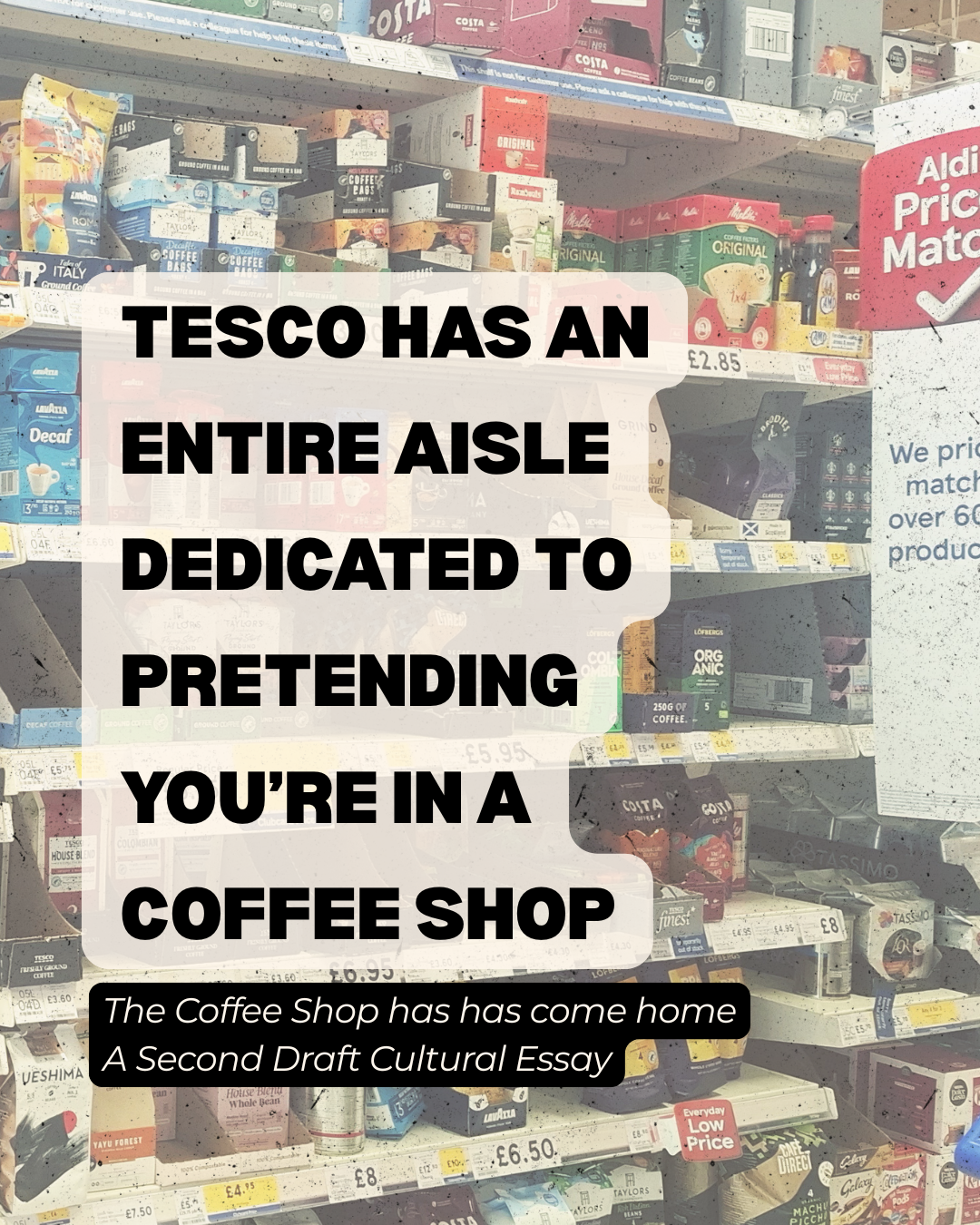
Why millennials are recreating café culture at home through syrups, rituals, aesthetics and “special coffees”.

There is an entire aisle in Tesco now dedicated to pretending you are in a coffee shop.
Not coffee itself. Coffee has always existed. I mean the performance around it.
Caramel syrups. Vanilla syrups. Skinny syrups. Cold foam. Iced latte cans. Starbucks branded sachets. Instant cappuccino packets promising “coffee shop taste at home”. Tiny tubs of cinnamon dust. Protein coffees. Fancy ice cube trays. Milk frothers.
You can now buy an entire personality in the hot drinks aisle.
And I don’t even mean this critically. I am fully part of the problem.
Coffee Isn’t Just Coffee Anymore
At some point over the last decade, “having a coffee” stopped meaning caffeine and started meaning an experience. A ritual. A small emotional event in the middle of the day.
The modern coffee shop occupies a strange position in contemporary life: part workplace, part social space, part self-care ritual and part performance of productivity. I was at my local spot and saw two laptops and what was clearly another two pairs having a pseudo meeting in their lanyards, and I live pretty rural.
And despite rising costs, demand for that experience has remained remarkably strong.
According to UK coffee market statistics, 80% of people who visit coffee shops do so at least once a week, while millennials are the generation most likely to visit regularly, often multiple times per week.
At the same time, the price of coffee continues to rise.
Data from the Office for National Statistics shows that the average price of instant coffee has risen dramatically over the past few decades, climbing from roughly £1.32 in 1990 to around £3.85 in January 2025. Coffee shop prices have followed the same trend, with chain coffee prices increasing significantly between 2022 and 2025.

And yet people clearly do not want to give up the ritual.
Instead, they appear to be recreating it domestically.
The supermarket coffee aisle increasingly resembles a café menu because consumers are no longer simply buying coffee. They are buying an atmosphere. Mood. Routine. Identity.
The Rise of the “Special Coffee”
I see it on Bookstagram, people posing their book on a perfectly made bed or shelf with a hot cup of coffee. It’s synonymous with comfort, productivity and self-care.A book beside a latte signals a certain kind of life. Calm. Intelligent. Soft around the edges. I find the image appealing because I think many of us want the life it represents.
The rise of “coffee shop at home” products reflects something larger about modern consumer culture. We increasingly purchase symbols of experiences rather than the experiences themselves.
A Nescafe vanilla latte sachet (my personal favorite) is not just a vanilla latte sachet. It is the suggestion of a little treat, taking a bit of time for myself. It’s a brief imitation of the café environment many people associate with calmness, aspiration and personal time. In our house, my husband will ask if I want ‘a coffee coffee or a special coffee’. The special association makes it a treat.
Fancy another cultural hot take? Have a look at this essay about women and guilty pleasures.
Third Places and Tiny Treats
This becomes particularly important in a period marked by financial pressure and social fragmentation in the post-Covid world. Certainly I’ve found it in my maternity leave. I don’t have the time, funds and sometimes willpower to rally the kids out the house so I can get a drink, but sitting down with a frothy cappuccino knock off in a leopard print mug while CeBeebies is on is 100% doable.

Historically, sociologists have described cafés and pubs as “third places”: spaces separate from home and work where people could exist socially and informally. But many third places have become increasingly commercialised or financially inaccessible.
The coffee shop remains one of the few socially acceptable places where people can spend time alone without appearing unusual. You can work there. Read there. Journal there. Delay going home there.
Buying the Feeling
But when even small luxuries begin to feel expensive, the ritual survives in altered form.
So people bring the coffee shop into the house instead.
Not the actual café itself, necessarily, but the aesthetics of it.

The syrups.
The iced tumblers.
The protein cold brews.
The desk set-ups that are designed to look vaguely like a productive writer in an independent café.
In many ways, the modern home coffee trend feels less like a food trend and more like an attempt to recreate emotional infrastructure.
People are not only trying to make coffee.
They are trying to manufacture the feeling of having their life briefly under control. Millennials will spend £40 attempting to recreate a £4 experience.
Which is, in itself, an incredibly millennial thing to do.
Even in the middle of rising prices, loneliness and endless productivity culture, people are still trying to carve out small moments of softness for themselves.
Even if it comes in the form of a £4 bottle of vanilla syrup and a homemade iced latte before work.
References
- Office for National Statistics. Consumer price inflation time series data. Accessed May 2026.
- Office for National Statistics. Coffee and hot drinks price index data. Accessed May 2026.
- Corner Coffee Store. UK Coffee Statistics. Accessed May 2026.
- Corner Coffee Store. 80% of people that visit coffee shops visit at least once a week. Accessed May 2026.
- Lumina Intelligence. UK Coffee Market Size, Growth, Share & Statistics 2025. Accessed May 2026.
- Silver Oak Coffee. Why Coffee Prices Are Rising in the UK – 2025 Insight. Accessed May 2026.
- Working From Coffee Shops. UK Coffee Shop Menus and Prices. Accessed May 2026.
Follow me on instagram


