
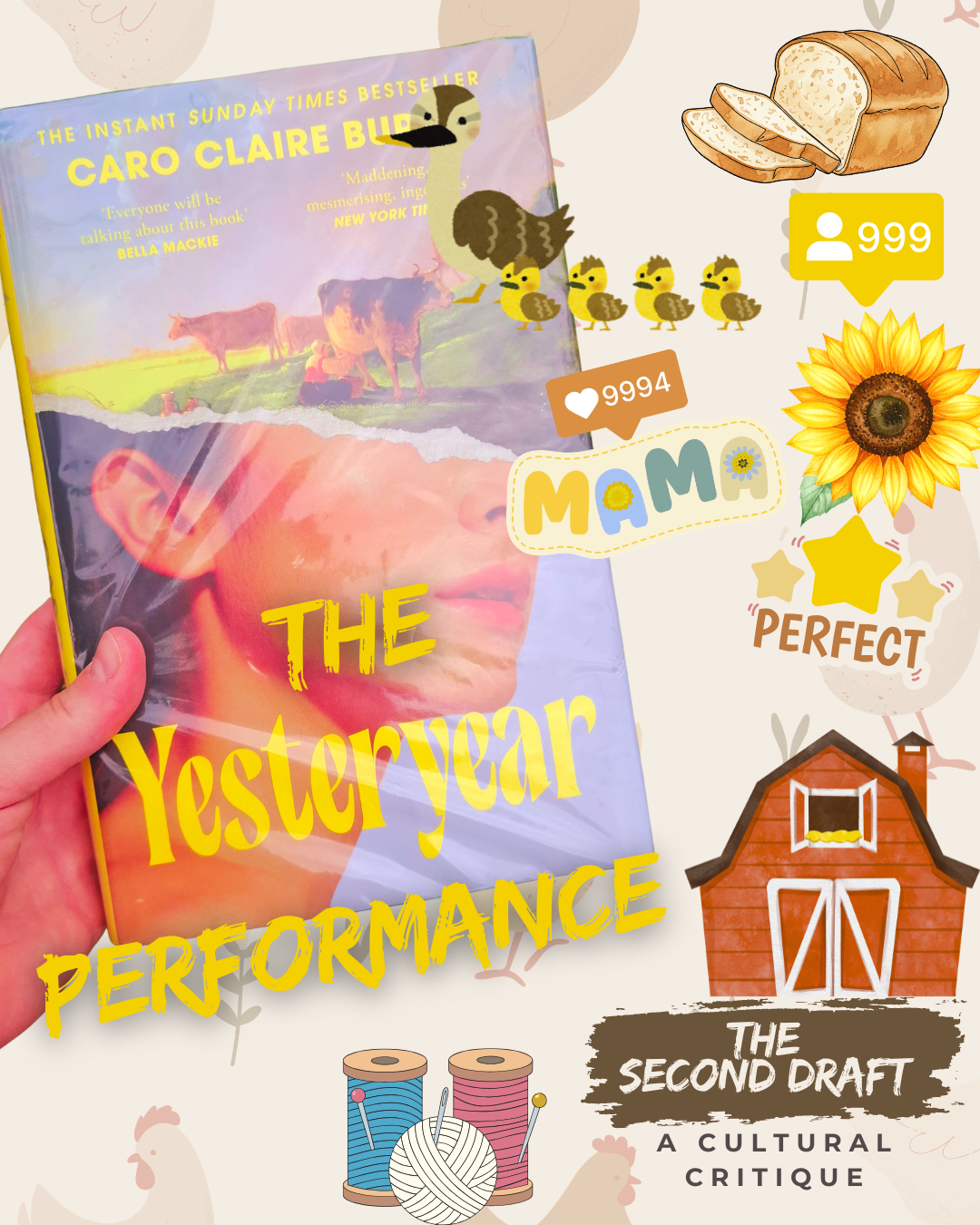
Parenting, performance, and the uncomfortable appeal of looking like we’re doing it right.
I had a visceral reaction to the ending of Yesteryear. However, it had nothing to do with tradwives or the usual discourses doing the rounds on social media right now.
It was to do with the children.
Here’s my headspace going into Yesteryear. I’m 36. I’m on mat leave. I have two kids. I work with young people. I’m married (to a man). I spend a lot of time online and love a bit of culture.
I Thought This Was Going to Be About Tradwives
When I heard about Yesteryear, I knew it had to go onto my TBR. It was relevant and had a catchy hook: tradwife influencer ends up living in pilgrim tradwife times.
And so I went into the book expecting to explore the tradwife element. While the book covers that ground well, it wasn’t the thing that hit me. In fact, I would argue that isn’t really what the book is about at all.
This makes the online slating of the book by self-styled tradwives all the funnier. It gives major ‘didn’t get past the first 100 pages’ energy. I know because at the 100-page mark I felt stuck. Was this really going to just analyse tradwife culture in religious middle America?
Then it turned.
This will get plot-spoily. If you haven’t read it and intend to, leave now. (But also come back after.)

As Natalie, the MC, realises the uselessness of her husband and the power of Instagram, she dives headfirst into an online performance persona. The narrative uses one of my favourite techniques in prose: the italicised inner thought.
Like this? Can anyone else hear this except me? Does anyone know I’ve posted about being online before?
Natalie’s performance persona — smile, be perfect, wait for the camera shot — takes over her life. She becomes the product she sells online.
And the product she sells is the tradwife life.
I’ll be honest. In my 30s and with small children, I get the appeal of having one parent at home to do the childcare while the other goes out to work. Divide and conquer. I’m sadly aware that a lot of the appeal of the tradwife, particularly to men, is not about that teamwork element, but that’s a blog post for an entirely different day.
Anyone who chooses the trad life for their family unit? Cool. Love that for you. Divide and conquer.
Yesteryear complicates that choice anyway. Natalie’s life has, to some extent, been thrust upon her by the incompetence and unwillingness of her husband to step up and be a teammate in either marriage or parenting. There is something almost admirable about the hustle required to keep a family with no real breadwinner afloat by turning herself into a lifestyle product.
The Unwilling Participants
But all of this ignores the unwilling participants in the performance.
The children.
Clementine, in particular, embodies the underlying tension of children being forced to speak without anyone actually listening to them. And that tension is not subtle. Natalie confesses that she has hated Clementine from the day she was born.
That hit me.
I Understand the Performance
I understand first-hand the anxiety of being a new mother and the fear of not immediately understanding whether you love your child.
I knew I would do anything for that baby. I knew I would care for him, sacrifice sleep and sanity; hell, I’d fight a stranger for looking at him with anything but compassion. But love? Maternal love was only something I could truly embrace once my initial anxieties dissipated. Once I’d figured out how to keep a baby alive, I could finally hold his little hand and whisper, I love you.
At the same time, I was performing motherhood for everyone around me.

Would the health visitor take the child away if they spotted I hadn’t hoovered? Would the other mothers at Bookbug look down on me if I hadn’t washed my hair? Would people in public judge me if my baby lost a sock?
There was the private reality of early motherhood — anxious, exhausted, trying to keep a tiny human alive — and then there was what I thought motherhood was supposed to look like from the outside.
With my second maternity leave, I’m much more chilled out. But the performance hasn’t completely disappeared. My eldest is about to start nursery. Am I expected to post it on Facebook? Was I supposed to buy the little chalkboard for the photo opportunity?
They’re silly examples, but that’s partly the point.
And maybe that’s why Natalie got under my skin. I don’t understand neglecting your children for content. I don’t understand hating your daughter. But I understand wanting to look like you’re doing this properly. I understand wondering whether everyone else got the memo about the nursery chalkboard.
I understand the performance.
And perhaps that’s more uncomfortable than simply being able to condemn it.
Performative parenting is incredibly normal.
We have always performed parenthood to some extent. We want the health visitor to think we’re coping. We want other parents to think we’re doing a decent job. We want Grandma to see the lovely photo rather than the screaming meltdown that happened ten minutes before it.
Social media didn’t invent that.
It did, however, give the performance an audience.
And Yesteryear takes that idea to its ugliest extreme.
Natalie becomes exceptionally good at looking like a good mother. The bread. The semi-feral children. The dresses. The million-dollar house. The chickens. The brood of many.
She knows exactly what motherhood is supposed to look like.
Meanwhile, Clementine is right there.
That’s what I couldn’t shake after finishing the book. There is a difference between parenting that happens to be visible and parenting that is altered by the need to be visible. Natalie isn’t simply sharing her children online. They become part of the product. Their childhood becomes evidence that the lifestyle works and, by extension, that Natalie is the mother she claims to be.
The performance of attentive motherhood becomes more important than actually paying attention to the children.
Who Is the Performance For?
And yet Natalie couldn’t perform any of this without an audience.
That’s the part where things get uncomfortable for the rest of us.
What do we want motherhood to look like online?
We like the bread. We like the beautiful house. We like the children running barefoot outside. We like the packed lunches, handmade dresses, immaculate bedrooms and wholesome family traditions. None of those things are bad. Plenty of them are lovely.
But they are also incredibly easy to photograph.
Whether a child feels listened to isn’t.
Whether they feel safe isn’t.
Whether their parent actually likes spending time with them isn’t.

The algorithm can’t tell the difference.
It can’t know whether the smiling child wanted to be filmed, what was happening five minutes before the spotless kitchen was photographed, or whether the beautiful family moment stopped being beautiful as soon as the camera did. It can only reward what it sees.
And so can we.
That’s where I fear I may be complicit in the pressure of performative parenting too. Not because I’ve built a parenting brand or turned my children into content, but because I’m part of the audience. I know the visual language. I recognise the perfect nursery photograph. I understand why the chalkboard exists. I’ve absorbed enough of it to wonder whether I’m supposed to buy one.
Maybe that’s what I found so uncomfortable about Yesteryear.
Natalie is responsible for what she does to her children. I’m not interested in absolving her of that. But the performance doesn’t exist in isolation. Platforms reward it. Audiences consume it. Other parents absorb it. We reproduce little pieces of it ourselves.
And caught somewhere in the middle are children who never agreed to perform at all.
Yesteryear didn’t make me afraid of women choosing traditional motherhood.
It made me afraid of what happens when looking like a good parent becomes more important than being one.

Essay by Emma Sinclair
Emma Sinclair is a Scottish writer and book reviewer behind The Second Draft. She writes about books, culture and the things she can’t stop thinking about, from speculative fiction and internet history to the odd ideas hidden between the pages.
Check out The Second Draft’s latest culture posts
Follow me on Instagram!


