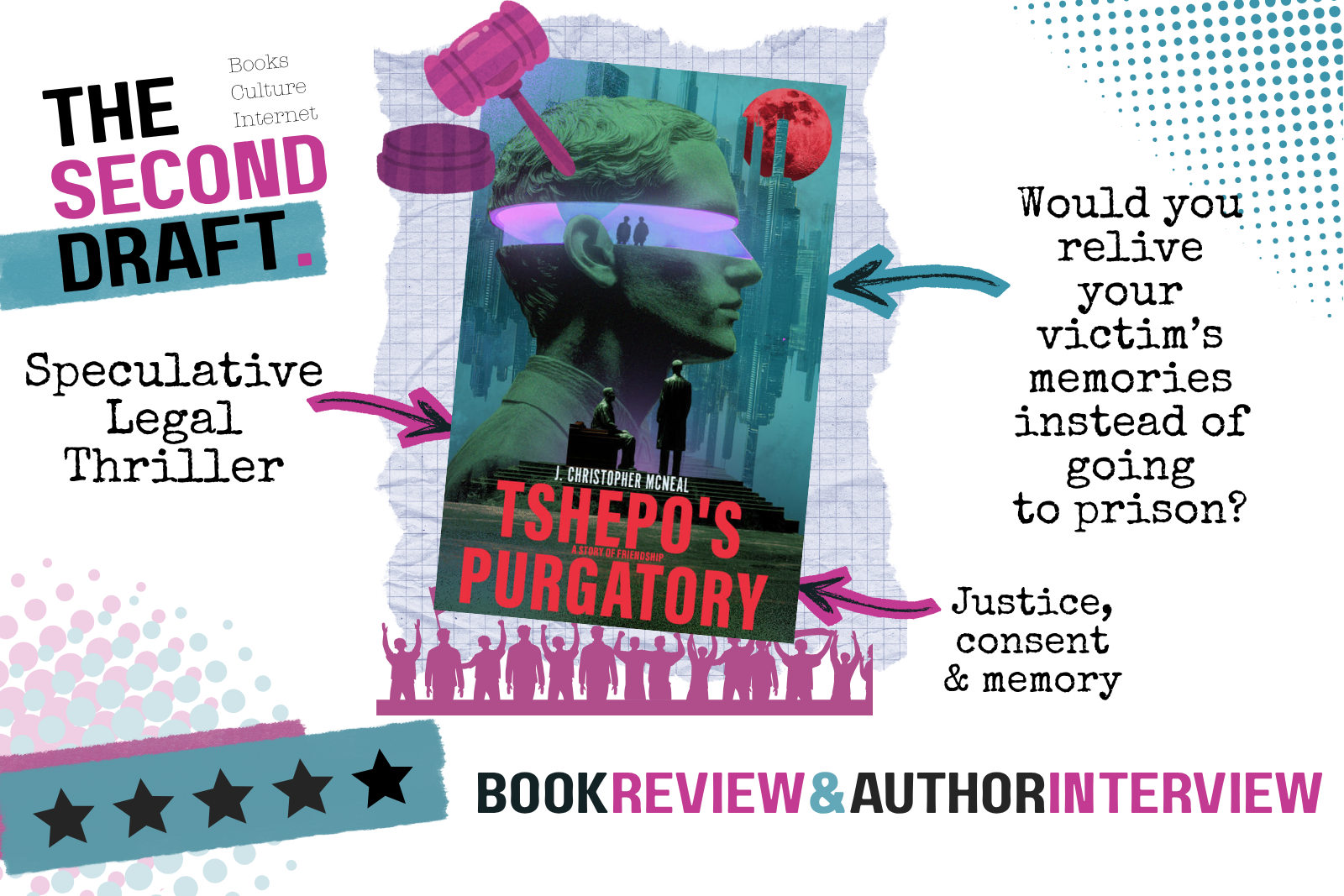
Christopher Nolan meets John Grisham in J. Christopher McNeal’s 5 star speculative legal thriller. In conversation with the author, I ask what it would take to make him a supporter of his own unsettling invention.
The objections were my favourite bit. I went into Tshepo’s Purgatory expecting to be hooked by a device that can put someone else’s memories in your head. Instead, I kept looking forward to the next witness and the moment one lawyer spotted a problem in the other’s argument. It’s Law & Order with a sci-fi premise big enough to make the lawyers’ jobs even more interesting.

It’s 2091 and defence lawyer Roddy Allistair is representing Luther Spalding, a leader of the Independent Consortium, which opposes the Purgatory devices. Courts offer the technology as an alternative to incarceration. Cardinal Kitso Tshepo believes that experiencing the harm you’ve caused from someone else’s perspective could teach you something years in prison never would.
Objection, Your Honour
“When I question a witness, my mind zigzags between the mind of my witness and the mind of the listener,” McNeal, who practises law in the US, told me. “If the testimony can paint a picture that is coherent, vivid, and relatable, your chances of persuading the listener improve.”
His courtroom scenes make you that listener. You’re learning how this future works while trying to decide how much weight to give the person explaining it, and somebody else in the room has a professional interest in making you change your mind.
McNeal says he wanted to show “the ways that a legal system can be at odds with itself”. Roddy secures a Purgatory sentence for one client, then has to go back to Arkansas to get permission for the man to undergo the very sentence he’s just won. It’s a maddening complication, and it makes the legal system feel lived in. I liked having to work out who actually had the power to make the decision alongside Roddy. “Laws are born, bent, and broken because of a story that began with humans,” McNeal says. Here, you get to watch people bend them in real time.
It did take me a while to read. There were stretches where I had to stop and get straight who was arguing what, and occasionally I wanted things to move a bit faster. The courtroom scenes were where that attention paid off. An objection could make me realise I’d accepted a witness’s version of events before I’d even thought to question it.
Roddy Allistair is a guy with a job
He’s good at his job and he gets paid. Fair enough. I could see why he made some morally grey choices, even when I felt uneasy about them. What makes his perspective feel so lawyerly is that when somebody presents an argument he has every reason to dismiss, you can feel him turning it over anyway, even as he looks for a way to keep believing what he already believes.
“Probably closer to bad to less bad,” is how McNeal describes Roddy’s character arc. He drew on his own early years in law. “I was strapped for cash, anxious, obsessive, and earnest.” He also remembers losing friends as he became less politically and religiously conservative. That detail helped me see what admitting somebody else has a point might cost Roddy. Changing your mind about a principle can mean losing the people you’ve always shared it with.
A better life in Little Rock
The class system in Little Rock might be my favourite idea outside the courtroom. Residents are sorted into A, B and C classes, with a vast transport system called the 630 Super Pass enforcing the divisions between them. What I found so clever about it was the promise that life could be better. That’s the American dream condensed into one city. If you can picture yourself moving up, you have a reason to keep investing in the system that decides where you belong. I kept thinking about how much easier it is to ask what I’d have to do to get into the next class than to ask who gets to divide the city up in the first place.
McNeal knows the terrain he’s writing about. He talked about the bluffs, hollows and gorges that might give an organised militia cover, and the forests and swamplands that could help form a ring of defences. “I’ve been to each of the places I write about,” he told me. The detail I found most interesting, though, was the number on the Super Pass. The real Interstate 630 helped dismantle Little Rock’s West Ninth Street district, once a thriving centre of Black business and community life.
The Super Pass, McNeal says, “takes that history and pumps it with steroids”. That answer helped me see why his 2091 felt so familiar. The transport is futuristic, but the people in charge still get to decide who lives where.

Would you choose Purgatory?
I’d described the procedure as compulsory in my question to McNeal. He pointed out that someone offered it can refuse and serve a prison sentence instead. That left me wondering how freely anyone can choose with prison on the other side of the decision. “I wanted to tell a story with complicated sci-fi devices without sacrificing the complicated human beings who inhabit the worlds shaped by the technology.”
So where did he come down on it? If he were presented with a device that demonstrably rehabilitated offenders, reconciled enemies and let ordinary people experience lives they’d otherwise never encounter, would he support it? “Of course I would! And I would be so annoying about it. I’m not that special.”
I loved that answer. It made me take the Cardinal’s case more seriously. I can see why someone would want a better way to get an offender to understand the harm they’ve caused. I still kept coming back to the person whose memories would have to be used. Their experience might be the thing that allows someone else to change.
What would it feel like to have the worst thing that happened to you become part of somebody else’s sentence?
And the ending? Chef’s kiss. After all that courtroom argument, the quiet of it caught me off guard. I’d spent the book wondering what it would do to a person to live inside somebody else’s memories. I finished it thinking about how hard it can be to sit with your own.
A solid 5 out of 5 stars. Tshepo’s Purgatory is one of my most unusual reads of the year. I’d happily read more science fiction that lets me get to know a new world one objection at a time.
Buy Tshepo’s Purgatory here.
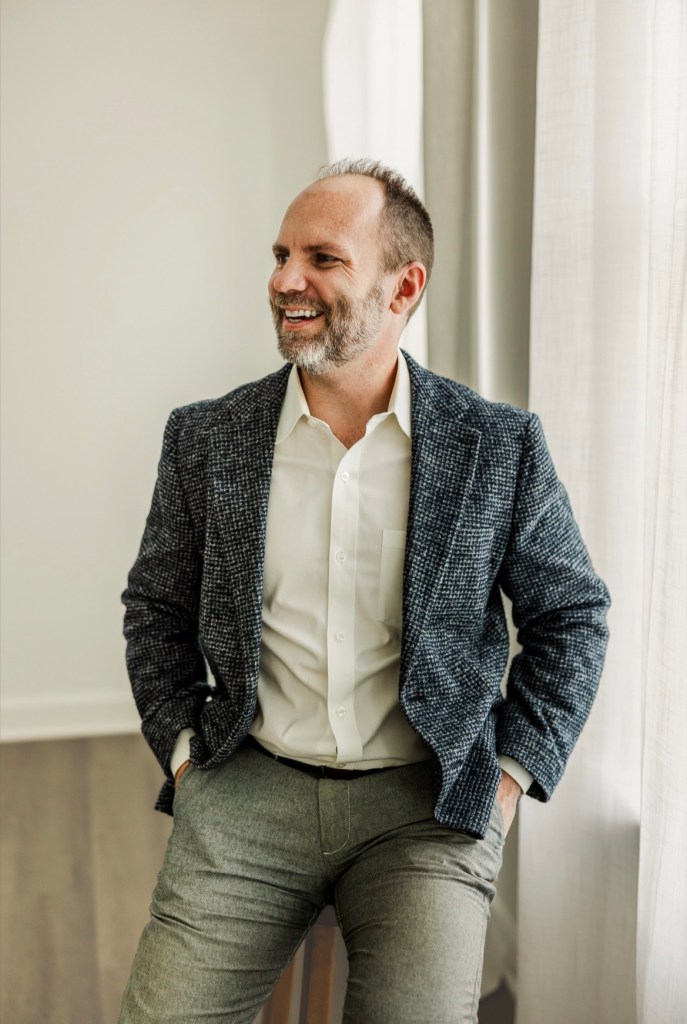
About the Author
Website: jchristophermcneal.com
Instagram:
@jchristophermcneal
Goodreads:
J. Christopher McNeal

Review by Emma Sinclair
Emma Sinclair is a Scottish writer and book reviewer behind The Second Draft. She writes about books, culture and the things she can’t stop thinking about, from speculative fiction and internet history to the odd ideas hidden between the pages.
Latest Posts
- Tshepo’s Purgatory Review- The Case for Purgatory
- An Internet Worth Bookmarking
- No, the Book Won’t Speak for Itself

Follow me on instagram



Leave a Reply